By Nicole C. Brambila
The Reading Eagle
March 4, 2018
After Marie Frisby’s husband fell prey to an all-too-common financial scam directed at the elderly, Montgomery County’s Orphans Court appointed a professional guardian to protect his estate.
The couple, who had separated over mounting debt and increasingly aggressive creditors, reconciled and Marie Frisby moved back into their colonial-style home on a quiet, tree-lined street in Wyncote.
With a guardian in place handling the estate, the financial woes that had plagued Marie and Hank Frisby for more than two years finally seemed behind them.
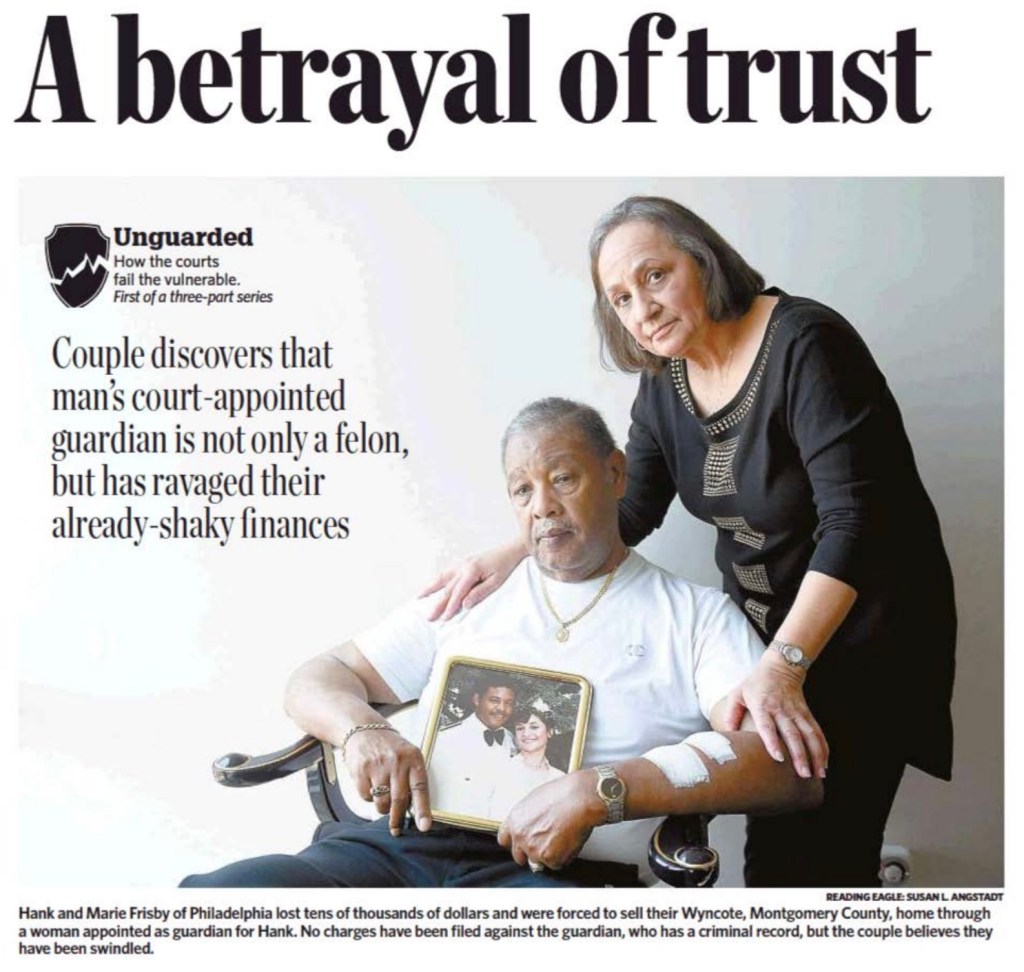
And then a county deputy sheriff knocked on their door.
The Police and Fire Credit Union, the deputy said with an apology, was foreclosing on their property.
“I was like, ‘This can’t be true,”” said Marie Frisby, 70.
Then she added, speaking of her husband’s court-appointed guardian, “Gloria Byars told me everything was being taken care of.”
In 2016, Byars was named the guardian for Hank Frisby, 79, during the time the couple had separated and filed for divorce.
When the court rules an adult incapacitated and appoints a guardian, the individual loses the right to make health care decisions, to determine where he lives or how his money is spent. Guardians make those decisions.
If the Frisbys were astonished to learn that court-appointed guardian had not been paying the mortgage and other bills, their surprise would pale in comparison to the revelations yet to come.
Unbeknownst to them, Byars had been convicted multiple times of financial theft.
Her most recent arrest came in 2005. She pleaded guilty to felony fraud and was sentenced to 37 months in a federal prison after cashing $20,000 in blank checks found rummaging through trash cans at a Virginia post office.
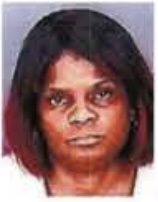
Federal dockets show Byars was paroled on supervised release in 2008, the same year – according to her LinkedIn account – she began working in Philadelphia with RES Consulting, which provides guardian services.
Although a story on her Virginia arrest can be found through an online search of “Gloria Byars” Adult Protective Services in at elast two counties – Montgomery and Philadelphia – frequently recommended to the court that she serve as a guardian.
Unlike California and Texas, which ban convicted felons from hanging out a shingle, Pennsylvania has no such standards. Like most states, Pennsylvania statute does not require a criminal background check.
Any remedy would require judicial and legislative fixes.
A proposed rule – used only as guidance for the courts – is before the Pennsylvania Supreme Court. It’s uncertain, though, if an when justices will adopt the proposal.
Advocates for the elderly were appalled that the very agencies tasked with protecting the frail and vulnerable took no steps to ensure they would not be further victimized.
“Guardianship is a law of protection,” said Elaine Renoire, president of the National Association to Stop Guardianship Abuse.
Renoire added: “You can’t protect people if you remove them from dangerous situations and put them in another one. It’s outrageous.”
Byars, 57, who has not been charged with any criminal conduct related to her actions as a court-appointed guardian, declined to comment for this story. A judge ahs called her conduct reckless and she has since been removed from her cases.
Philadelphia Corporation for Aging President Holly Lange, whose agency repeatedly recommended Byars, declined to comment, and Robert Stump, a guardian with RES Consulting, did not return multiple phone calls.
Montgomery County Aging & Adult Services Administrator Doreen Hespell referred questions to Kaitlyn Foti, a spokeswoman for county commissioners, who have oversight.
“In recommending guardian, our office of Aging and Adult Services follows state regulations, which do not require a criminal background check,” Foti said in an email to the Reading Eagle.
That’s little comfort for the Frisbys.
Marie Frisby estimates – between guardian and attorney’s fees, and the money that’s unaccounted for – they lost roughly $80,000 in the nearly 15 months Byars served as guardian.
“I thought, “ Marie Frisby said, when calculating the loss, “’Oh my god, Hank is being scammed again.’”
Financial mess
The court appointed Byars permanent guardian of Hank Frisby in March 2016. Less than 15 months later Byars would be removed. But in that time, at least two government liens would be levied again the Frisbys home.
Before the court appointed another guardian, Byars would sell the Frisbys second house, leaving Hank Frisby’s daughter and grandson homeless.
And the couple would be forced to sell their Wyncote home to pay all the unpaid bills, including tens of thousands in fees to Byars and her attorney, Robert L. Feliciani III. (Guardians routinely hire or consult with attorneys who prepare their legal documents.)
Feliciani, who has a Montgomery County practice that advertises expertise in orphans court litigation and fiduciary representation, did not respond to a phone call and email seeking comment.
Because the deputy’s knock on the door came just six weeks after Marie Frisby moved back in, it’s unclear what financial mess Byars may have stepped into with her appointment nine months earlier. What is clear, though, is the expectation Byars would straighten things out was never realized.
“She had been guardian all that time, and the debt just kept going up because she wasn’t paying all the bills,” Marie Frisby said.
Byars may not have been keeping up with the bills, but she meticulously kept track of her charges, which she submitted to the court.
An invoice dated Feb. 14, 2017, shows more than $17,000 in guardianship fees assessed over eight months that include: $750 for a birthday party with a live band for all her wars complete with a birthday cake for each (Hank Frisby is diabetic); $375 for a three-hour visit with him at the nursing home to play games; and $500 to sit with himn for four hours during a dialysis treatment.
Her invoice reads like a taxi meter clicking away charges for everything she did: $37.50 to pay bills; $12.50 to read text messages; $125 to email her attorney.
She even charged $112.50 to write a check to her own company, Global Guardian Services, for her monthly fee.
Eventually they negotiated a lower fee, but had Marie Frisby not advocated for her husband, he very likely would have had to pay the entire amount because judges routinely sign off on guardianship expenses, advocates say.
Eight months after Byars’ removal, much remains unaccounted for.
For example, why couldn’t Byars manage on hank Frisby’s sizeable pension income, which included retirement pay for a brigadier general? And what become of the more than $20,000 in retirement income held in escrow before Byars’ appointment?
Marie Frisby doubts they’ll receive an accounting.
Because expenditures are court approved, it’s unclear what, if any, recourse the Frisbys might have.
‘Unfit to serve’
If Montgomery Aging officials knew they had repeatedly recommended a convicted felon to serve as guardian, it was a closely held secret. That is until Byars petitioned Philadelphia’s Orphans Court on April 26 to sell the homes of Edmund and Margareta Berg, a move that would lead to her undoing.
Recommended by the Philadelphia Corporation for Aging, the court appointed Byars as guardian for the Bergs in December 2015 after a relative declined with the understanding the couple would remain in their home.
In rather short order, though, Byars moved the Bergs into a nursing facility.
The couple’s relative promptly hired Daniel P. McElhatton, a Philadelphia attorney who did what no one else had thought to do: a background check.
What he found would result in Byars being immediately removed as the Bergs’ guardian as well as from dozens of other cases in which Judge John W. Herron had appointed her.
In his response to Byars’ petition, McElhatton exposed her Virginia convictions for theft, passing bad checks and forgery. He also asserted – using Byars’ own Facebook posts – that she had hired her husband’s clean-out company, DEPCO LLC, to remove property from the Bergs’ home without disclosing it to the court.
“Based upon the prior convictions and her self-dealing with her husband’s company, which was undisclosed, petitioner asserts that Gloria Byars is unfit to serve as plenary guardian and that she be removed from that position,” McElhatton wrote.
In the hearing that followed, Byars disclosed she had paid her husband $11,500 for the Berg cleanout before obtaining court approval. And she admitted to making an irregular $5,000 cash payment to a nursing home employee.
In his order removing Byars, Herron said her admissions were extremely concerning. He also described her conduct as reckless.
While Herron moved swiftly to remove her, other Philadelphia judges did not.
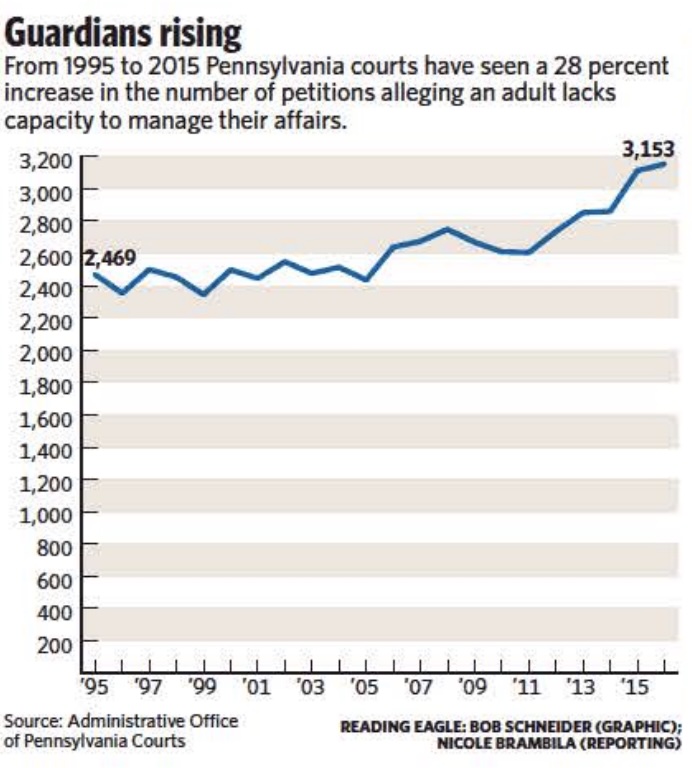
For six months she continued serving as guardian to 52 incapacitated Philadelphians. No other Philadelphia judge removed her until after the Reading Eagle made dozens of inquiries in January with the court, Adult Protective Services, the Pennsylvania Department of Aging and state lawmakers about her appointments.
Herron declined to comment, as did Judge Matthew D. Carrafiello, who oversees Philadelphia Orphans Court.
The decision to keep Byars on – one court official said – was driven by a shortage of professional guardians. An estimated seven to 10 more are needed to keep up with demand.
Part of the scarcity is purely economic. There’s very little money to be made as a guardian, unless the incapacitated has money.
Philadelphia Orphans Court works with more than a dozen professional guardians. Ten of these, including Byars, carry some of the highest caseloads: 22, 48, 54 and more. But none more than Byars, who was appointed in Philadelphia alone 75 times from 2014 through 2016, according to court dockets.
National studies recommend a caseload ration of 1:20.
“Due to the number of cases she had, it would have been overly burdensome to those wards in her care to remove Ms. Byars as guardian absent an available guardian whose work for other wards would not be adversely affected,” said Gabriel Roberts, a court spokesperson.
‘Lapse in our procedures’
Every court and oversight agency with whom the Reading Eagle spoke pointed fingers at one another.
The courts blamed Adult Protective Services for recommending Byars. Adult Protective Services blamed state statue, which doesn’t require a criminal background check. And the Pennsylvania Department of Aging blamed the courts.
“At the end of the day, the court decides when a guardian is appointed, and they have the responsibility to continue monitoring them,” Aging Department spokesman Drew Wilburne said.
Sen. Art Haywood, a Philadelphia Democrat and minority chair of the Senate Aging and Youth Republican chair, referred questions to Chloe Mandara, the committee’s executive director, who didn’t respond to multiple emails and phone calls.
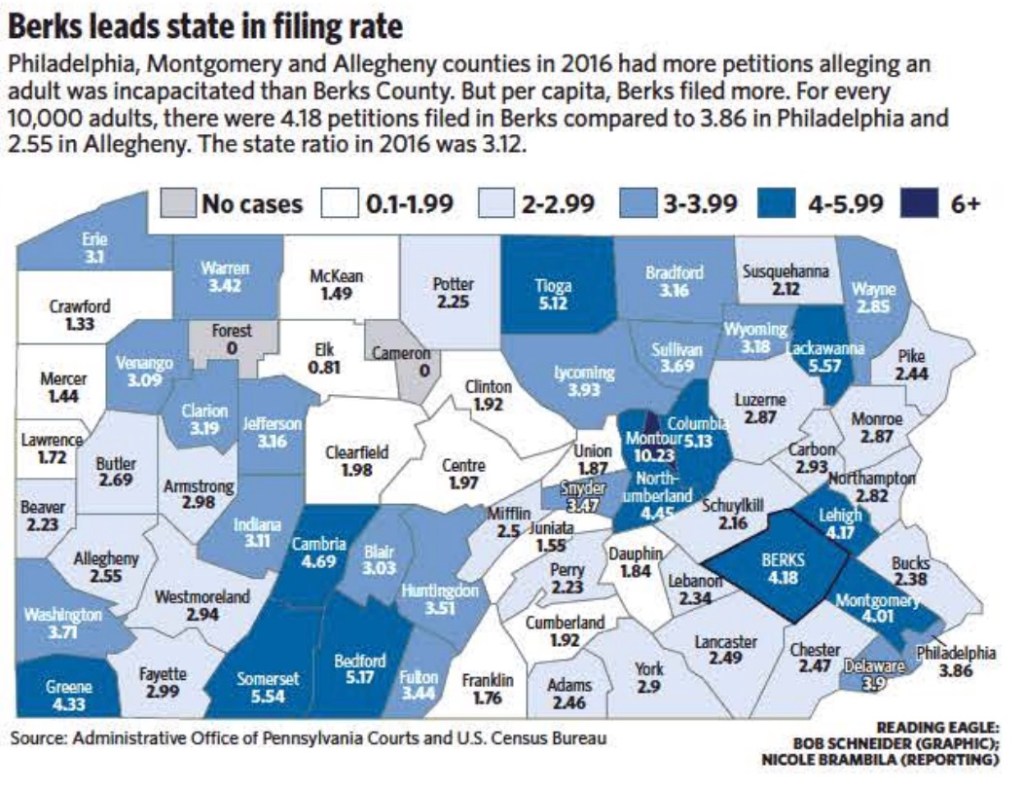
Only Rep. Tim Hennessey, a Pottstown Republican and chairman of the House Aging and Older Adults Services Committee, responded. But he downplayed Byars’ repeated appointments, calling it “a lapse in our procedures in how guardians get appointed.”
He forwarded the newspaper’s inquiry to the House Judiciary Committee and state Secretary of Aging Teresa Osborne, who did not respond to requests for comment.
But Hennessey also noted the reluctance of lawmakers to codify standards, likely to spare family members the expense of obtaining a criminal background check.
“We may not be able to totally prevent this type of thing, but we should make it much more difficult for it to happen again, “ Hennessey said.
A careful vetting, advocates say, doesn’t have to be a choice between all or nothing. States with guardian background checks often distinguish between family members and those making a livelihood off appointments.
In the wake of Byars’ criminal history coming out, the Montgomery court removed her from her remaining appointments, as did the Philadelphia court, which expects to replace Byars’ remaining cases with a new guardian by March 15.
Roberts, the Philadelphia court spokesman, said the court had fielded no complaints and discovered no malfeasance.
For the Frisbys, that’s little consolation.
“How can somebody with this kind of record be appointed to handle incompetent people’s money”” Marie Frisby asked. “How can the courts let this happen?”
 Nico Brambila