A desolate corner of California’s desert draws rebels, outcasts and loners.
By Nicole C. Brambila
The Desert Sun
Jan. 14, 2007
Don’t ask his last name — that would reveal too much.
“Just Rusty,” he says, his toothless gums pucker around his slim cigarette with each drag. “Or Outlaw.” With his boot, he smashed the butt of his cigarette into the ground near a “No Smoking” sign and lights another. “I don’t like to be official.”
Few here do. Most know each other by their nicknames. There’s Solar Mike, who runs a solar panel installation shop out of an old bus. And Builder Bill, the monotone-singing guitarist and owner of The Range, an outdoor stage decorated with hanging five-gallon paint buckets rigged with colored lights. And Library Ron, who maintains the Book Exchange.
Welcome to Slab City, a desolate corner of California’s desert that’s 58 miles southeast of Indio. The 200 or so residents consider the Slabs one of the few places left where a man — and a handful of women — can still start over away from prying suburban neighbors.
But that’s the romantic talking. And there are plenty of those here, despite the lack of running water and electricity in the killer heat that can hit 127 degrees.
They camp out year-round — “Mad Max” style — in dilapidated RVs throughout the scorching summer that claims lies each year, six in 10 days this past June.
“There’s one requirement to stay at the Slabs year-round: you’ve got be crazy,” says Library Ron. He’s a snowbird, but not in the owning-a-fancy-RV-loaded-with-all-the-amenities sense.
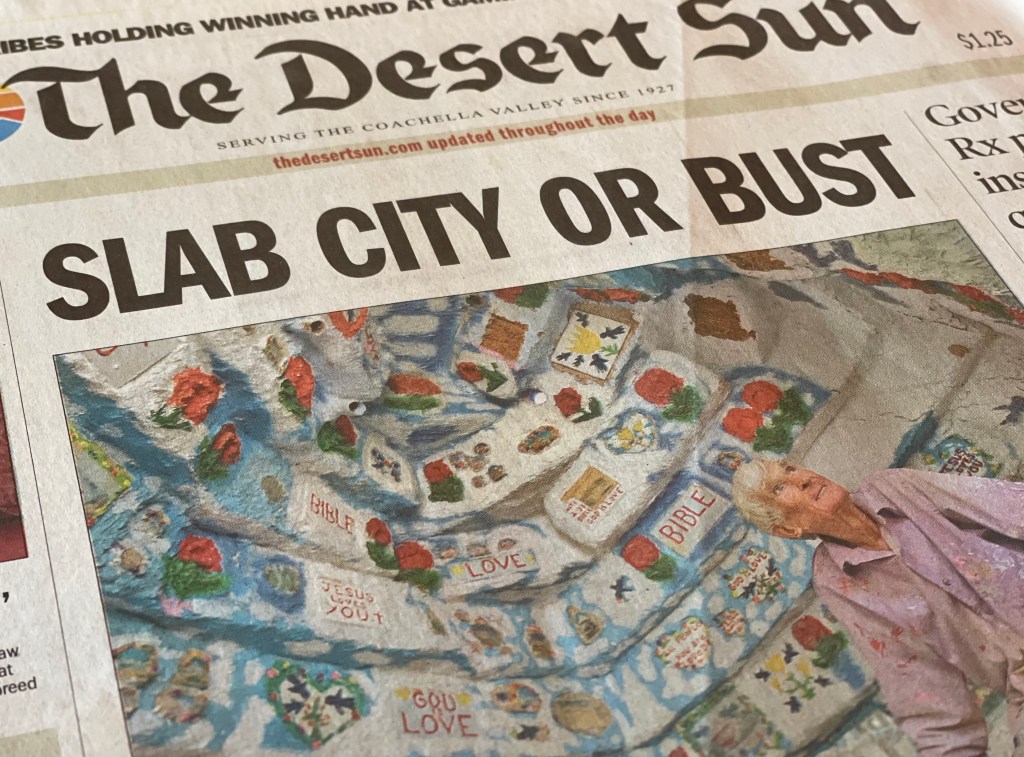
Once the weather cools, a caravan of RV snowbirds — some steering $500,000 rigs equipped with satellite TV and Internet — make the annual pilgrimage east down Highway 111, winding past the stench of the Salton Sea and Leonard’s mountain bathed in acrylics and Bible verses to a gravel oasis littered with not-yet-detonated cluster bombs, cactus and abandoned, desert junk.
“We get bad-mouthed because we’re living so rough, but it’s a rough life,” Rusty says, sipping iced coffee between cigarettes. “They think we’re all deadbeats and crooks.”
At 75, Rusty hasn’t held a job in more than three decades, sidelined by a disability. He doesn’t elaborate.
His graying ponytail and wrinkled skin lie shielded beneath a sweat-stained Army cap. The faded fatigues he wars day in and out in the blistering desert sun reek of sweat and grime. He could use his pension check to rent an apartment rather than squat near a live military bombing range residents describe — tongue and cheek — as the local entertainment, but the pittance he receives goes further here.
“Besides, who’d want me around them?” he says with a shrug.
At the Slabs, no one gawks with a disapproving eye. At the Slabs, no one needs intimate details — last names or permanent addresses, a background or occupation. At the Slabs, Rusty can be himself.
Slabbers romanticize rugged individualism here as though Slab City were the last bastion of the American West. But in many cases, they brought with them the very things they hoped to leave behind — poverty, crime and class envy.
‘Never boring’
Visitors discover the desert hideaway by word-of-mouth.
It’s not a city or even an unincorporated town, laden with none of what Slabbers would call the trappings of modern convenience — plumbing and sewers, street signs, lights and roads. There are no city ordinances, property taxes and close-to-home conveniences. The nearest Wal-Mart is more than 50 miles away, and they like it that way.
Located four miles east of Niland, it’s named for the concrete foundations that dot the one-square-mile area, remnants of World War II Marine barracks from Camp Dunlap. The California State Teacher’s Retirement System owns the land, which was part of a federal grant in 1853 for public education.
Even with all the media attention showered on Slab City — from the New York Times and Time Magazine to the “Weird California” coffee-table book and “ABC World News Tonight” — few of Imperial County’s residents actually know about the rent-free living that draws rebels, outcasts and loners.
“it’s easier to fit in with a lot of misfits and ruffians than snotty city folks,” said Nicole Morris, who moved to the Slabs this fall after she says she lost her kids to Child Protective Services and her home. The 25-year-old holds a job down in Niland.
The mystique is often lost on outsiders.
And it’s not just the dry camping in the oppressive heat. It’s the junk vistas that crowd many corners of Slab City, despite annual clean-up efforts. Some campsites lie in such disrepair it’s difficult to tell which ones are lived in. Slabbers move often because of hand-dug pits crammed with leaking oil drums of human sludge capped with plywood or debris and garbage.
“If you know what I know you wouldn’t think that it was an interesting place to visit,” says Niland Fire Chief Mike Aleksick, whose department responds to fire and medical emergencies in Slab City.
“And I don’t knock the people that stay out here,” he adds, snaking his pickup through the maze of desert growth and ramshackle homes searching for live military rounds. He repeats this trip every couple of weeks, adding explosives to the fire department’s growing stash.
During the tour, Aleksick stops, mid-sentence, and asks, “Was that a parachute?” He hits reverse and winds back to a small piece of orange and white fabric. Picking up the chute, he explains he attached cylinder is a live mortar round. “Our job is never boring.”
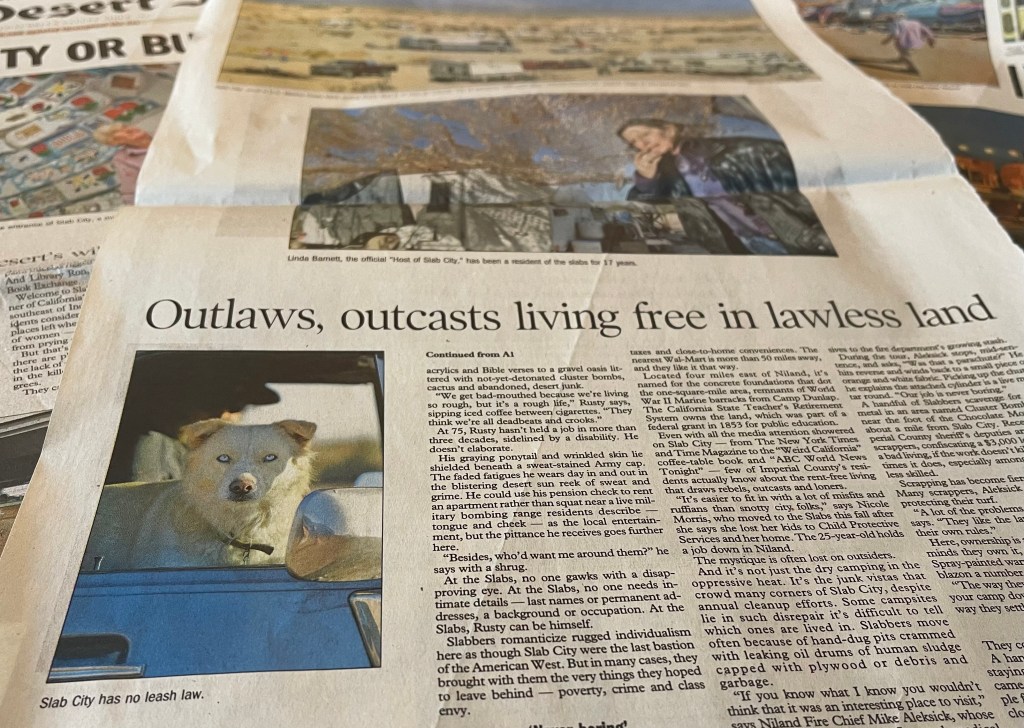
A handful of Slabbers scavenge for scrap metal in an area named Cluster Bomb Alley near the foot of the Chocolate Mountains, about a mile from Slab City. Recently, Imperial County sheriff’s deputies arrested two scrappers, confiscating a $3,000 load. It’s not a bad living, if the work doesn’t kill you. Sometimes it does, especially among the younger less skilled.
Scrapping has become fiercely competitive. Many scrappers, Aleksick says, carry guns, protecting their turf.
“A lot of the problems aren’t reported,” he says. “They like the lawlessness. They have their own rules.”
Here, ownership is a state of mind. If in their minds they own it, then you are trespassing. Spray-painted warnings such as “I’ll be back” blazon a number of the campsites.
“The way they feud out there is they’ll burn your camp down,” Aleksick says. “That’s the way they settle a lot of their stuff.”
‘A failed life’
They come for different reasons.
A handful came for a visit and ended up staying longer. Take James McGrew. He came to the Slabs seven years ago with a couple friends, an Oregon DUI warrant, a bag of clothes and a tent.
“They said they would be back,” he says, his hair desert blown like the infamous Nick Nolte drunk-driving mug shot. “I’ve never seen them since.”
For some, it’s the weather.
“The map never said nothing about 120 degrees,” Jerry Allen says with a smirk, the bits of breakfast clinging to the stubble on his chin rise and fall as he speaks. The mild desert winters, the 88-year-old explains, are good for his string of health problems.
Others headed west on a mission from God and created a sightseeing destination.
“I remember telling god I’m going to stay one week; 23 years later I’m still here,” says Leonard Knight in the spiel he gives the tourists who gawk at his creation — a three-story mount of paint and Scripture.
For still others, Slab City is an anti-suburbia escape.
“I love it out here because I’m not in the mess in Los Angeles,” says Jean Burghardt, a retired school bus driver who fled city life after being shot in a drive-by.
But for most, the real draw is the rent-free living — even among the estimated 3,000 RV club members who’d rather pocket the money they would have to pay somewhere else.
“You can build your bank account back up just sitting here,” says John Clairmont, a retired truck driver who’s been coming to the Slabs since 1991.
In some sort of bizarre “Twilight-Zone” twist, Slab City offers what the American dream promises, but suburbia sometimes cannot provide: something to call their own.
Before relocating to the Slabs six years ago, Builder Bill was a professional Dumpster diver, living out of his van in San Diego selling discarded finds at swap meets. At 57, he’s been homeless most of his adult years, the product of “a failed life,” he says.
“I came here because it’s the only place you can lie down for 10 days in a car and nobody bothers you,” he says, his words slow and slurred.
Clashing with snowbirds
The invisible line that separates the haves from the have-nots can clearly be seen from Leonard’s “Salvation Mountain.”
On one side, flags at half-staff honoring former President Ford flutter in front of tidy rows of sleek RVs towing sports cars and all-terrain vehicles. On the other, clusters of rickety school buses and camper tops with grubby couches surrounded with barbed wire.
Snowbirds and Slabbers don’t often mingle.
“This is kind of a bad place to be if you’re not with people that you trust,” says RV club member Donna Lee. “Just know you’ve got to keep your wits about you.”
Snowbirds talk of not walking alone and sticking close to camp. They socialize together over coffee at The patio, the three o’clock happy hours and the potluck dinners.
Slabbers talk about the perceived disdain Snowbirds have for them. They socialize together over alcohol and live music.
Authorities characterize Slab City as a seedy neighborhood rife with hoodlums and felons, refuse and disease.
“There are places you don’t go unless you’re arme3d out there,” says Aleksick, who says he’s been shot at three times and stabbed twice. “it’s a different world.”
Slabbers concede Slab City has had a bad element, but they quickly point out self-policing has eliminated most of it.
“Until you live here for a while you don’t realize it’s a nice place to live,” said Linda Barnette, who refused to be interviewed after dark because “it’s not safe.”
“We don’t have people out here that break the law full-time.”
Every couple of years a politician gets an itch to clean up the Slabs. Few Slabbers believe the county will be successful, if past attempts are any indication. They also feel protected in the shadow of “Salvation Mountain,” which draws untold curious tourists from across the globe. Shuttering the Slabs also means leveling Leonard’s mountain.
Officials call Slab City an environmental nightmare with all the human sewage cooking into the ground, undetonated military bombs and Leonard’s acrylic-soaked mountain many fear is splattered with lead-based paint.
“The fear is that it could become a huge environmental issue,” says Imperial County Supervisor Gary Wyatt, whose district includes Slab City. “Our country is not willing to take that on.”
Cleaning up Slab City, though, would exact a very real human cost. Shuttering the Slabs means a number of campers would become homeless.
“It doesn’t seem like it’s worth the money it would take to do it, which is why I think the situation has remained the way it is,” says Paul Thayer, California State Lands Commission executive officer.
“Leaving things this way may be the best solution right now.”
‘All I got’
Rusty figures he’ll die out here.
“I never thought I’d be here this long,” he says between drags on his cigarette.
He should be dead already. Or so he believes. The details never come. Maybe it’s the cigarettes or hard living or the mild stroke that left him self-conscious of an undetectable slur.
With his finger, he changes the subject.
“There,” he points to a shiny survivalist rig. “That’s my home. That is all I got.”
He hasn’t owned a traditional home since Richard Nixon was in the White House. He’s lived here 12 years and hasn’t seen his daughter in more than 20, except for a Polaroid he keeps in his pocket.
“It gets boring sometimes,” he says.
And lonely?
“Yeah,” he sighs. Rusty steps back, as if from the conversation. “There’s some good people out here,” he says, surveying the quiet. “They’re living free, same as me.”
© The Desert Sun
 Nico Brambila