The Desert Sun, economic analysis: Underground labor contributes $1.5 billion a
year, costs county $220 million
By Nicole C. Brambila
The Desert Sun
Dec. 10, 2006
EDITOR’S NOTE:
Coachella Valley residents are deeply divided over the impact of undocumented immigrants in our corner of Southern California. In this special report, we wanted to shed light so people could be better informed. We did not know where our research would lead us, and we did not start out with an agenda or a conclusion. We asked five social scientists who have studied the topic extensively to poke holes in how we approached the story. They agreed our approach was valid and, if anything, underestimated the contributions undocumented immigrants make. Please, let us know what you think.
— Steve Silberman, executive editor
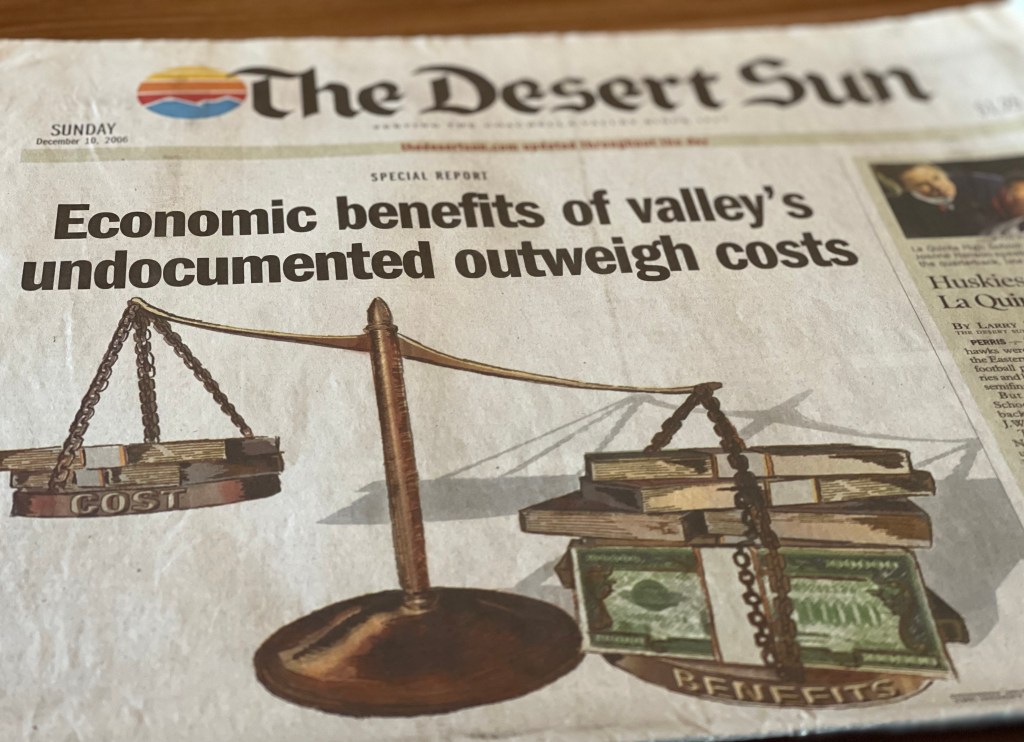
Undocumented immigrants pump nearly $1.5 billion annually into the Riverside County economy while costing residents 32 cents a day for the social services they use, an analysis conducted by The Desert Sun has estimated.
Extrapolated from the research of prominent social scientists, the findings – a roughly $1.5 billion economic boost and a nearly $220 million cost – surprised community leaders and immigration advocates alike. They assumed undocumented workers benefit the local economy, but they did not expect such a large financial windfall.
“It’s devastating to the economy if you remove ($1.5billion) of current activity and you have to go scramble for the workers from elsewhere. It will cost much more,” said Rick Daniels, executive director of the Coachella Valley Economic Partnership. The group consists of more than 140 businesses and public organizations to boost the valley’s economic base.
“It absolutely points out the folly of rounding up 11million people and transporting them out of the country.”
The estimated $1.5 billion undocumented workers earn in Riverside County mirrors the amount officials will collect in property taxes this year. It does not include income or sales taxes the undocumented pay, nor the money they contribute to Social Security.
The Desert Sun took national studies on the undocumented and then applied their findings to the estimated number living in Riverside County. The analysis assumes Riverside County mirrors national averages.
Five social scientists verified the analysis, saying it was a reasonable estimate. But they also said that any estimate makes assumptions about the size of the undocumented population, their employment and earning power, and their use of public services.
Nevertheless, the methodology provided a good starting point, the researchers said. Also, none of them disputed the newspaper’s finding of overwhelming economic benefits versus public costs of the undocumented.”
As rough as the numbers are, I think there is nothing wrong with it,” said Giovanni Peri, a University of California, Davis economics professor whose research focuses on wages and labor.
Added Greg Watson, a consultant at the Inter-American Development Bank in Washington, D.C., who has studied the topic: “That’s how I would have done it.”
Immigration advocates – who this year pressed Congress for citizenship for the estimated 11 million to 12 million undocumented immigrants living in the U.S. – have long believed undocumented workers buoy the economy with their cheap labor. But even these advocates said they were astounded by the financial contribution undocumented workers make to the local economy.
“I never thought it was that much money,” said Rosalio Plata, a Cathedral City resident who helped organize springtime marches that protested the U.S. House’s enforcement-only immigration bill.
As a 20-year-old, Plata sneaked across the border and then worked odd jobs in the shadows to help support his family in Mexico. He became a U.S. citizen through President Reagan’s amnesty program in the 1980s.
Today, Plata owns a valley insurance business.
For all the talk about the cost of undocumented immigration in coffee shops across the nation and in the halls of Congress, Riverside County officials did not know the exact price tag – or the economic benefit.
“I’m amazed; that’s a significant contribution to our economy,” said Riverside County Supervisor Roy Wilson.
Immigration opponents, however, remain unconvinced.
“If you squeeze it down to a tiny local area, I think that’s a big mistake because it’s a national issue,” said Evelyn Miller, a spokeswoman with the California Coalition for Immigration Reform.
“You go into dollar costs and you’re slicing your throat because they throw their figures back at you.”
Based in Huntington Beach, the coalition co-authored Proposition 187 in 1994 that would have denied public services to the undocumented. A federal court later overturned the voter-approved measure.
To tally the economic benefits, The Desert Sun multiplied the estimated size of the county’s undocumented worker population by the yearly salary from their first job and subtracted the 10 percent the majority of immigrants send to their country of origin to support family.
To tabulate the nearly $220 million estimated cost of undocumented migration to county residents, The Desert Sun used the three big budget items researchers look at – health care, public safety and education.
Both the benefit and the cost underestimate the real price tag, experts say.
Officials do not suggest they stop providing health care or education nor advocate releasing undocumented inmates from the county’s jails. But paying for those services does put an added strain on public agencies scrambling for enough funding
amid the county’s continual growth. Even so, the benefits far outweigh those costs, The Desert Sun analysis shows.
Of the estimated 233,000 undocumented immigrants living in Riverside County, about 154,300 are in the work force. Many of them fill jobs at a time when low unemployment rates pose a critical labor shortage in the Coachella Valley.
“There is no good way to identify (the undocumented),” said Hans Johnson, a demographer with the San Francisco-based Public Policy Institute of California. The nonprofit, nonpartisan group conducts research on economic, political and social issues. “There’s a lot of uncertainty here. We’re making best guesses.”
So why then, if the salaries of undocumented workers keep the local economy humming, does a Google search turn up much more research that documents skyrocketing social costs? Why is there an unrelenting perception that the undocumented are a financial burden?
“The cost is relatively easy to pinpoint,” said Esmael Adibi, an economist Chapman University in Orange and co-creator of The Desert Sun Economic Index. “The benefit is much more difficult to quantify.”
‘An unfair burden’?
Although the estimated cost pales in comparison to the $1.5 billion the local economy gains, $220 million isn’t an insignificant amount.
So what can $220 million buy?
That hefty boon could remove the hydrogen sulfide that causes the Salton Sea to stink.
Or, the money could complete the $80 million McCallum Theatre expansion project, build a high school and improve the interchange at Interstate 10 at Gene Autry Trail with several million left in change.
What, then, do county officials make of the expense of undocumented immigration?
County Supervisor Marion Ashley said he suspected the $220 million figure was low, partly because the calculation does not include county clinics, which provide services on a sliding fee regardless of residency.
The county does not track residency information on patients.
Other county officials would not say whether $220 million was exceedingly great or small.
No public study in Riverside County looks at the benefit or cost of undocumented immigration – or any other county in the state for that matter.
Why?
“No one’s prepared to act on the information,” answered Gary Feldman, Riverside County public health officer.
This indecision might reflect the mood of the American public, which remains sharply divided on whether the undocumented contribute to or hurt the economy.
Rep. Mary Bono, R-Palm Springs, characterized the impact of undocumented immigration as “an unfair burden on Californians.”
And what of the fiscal contributions of immigrants in Riverside County?
“Congresswoman Mary Bono has no doubt that many sectors of our nation’s economy depend on a strong workforce that has been served by immigrant populations,” said Jason Vasquez, Bono’s communications director.
In December 2005, Bono co-sponsored an enforcement-only immigration bill that divided the Republican Party and the nation. She also supports expanding the guest worker program.
Pro-immigrant groups hope the Democratic power shift in Congress will bode well for comprehensive immigration reform that includes a guest worker program with a pathway to citizenship.In defending the controversial House bill that would have built a $2 billion border fence and criminalized those who aid the undocumented, Bono pointed to escalating healthcare costs — blamed on immigrants using the emergency room as a physician’s office — and the state’s burgeoning classrooms and prison facilities.
“What’s important is not the number,” she said. “I think the strain on the system is obvious to anybody who works in the system.”
Ensuring the public services we enjoy today – police and fire protection, libraries and highways – means safeguarding the future tax base that sustains these services. And that means investing in today’s generation of children regardless of their immigration status, said Johnson of the Public Policy Institute.
HOW WE DID IT
Calculating the benefits and cost of undocumented immigration to Riverside County
THE UNDOCUMENTED BENEFIT
The Desert Sun used national studies that estimate the size and population and the earning power of the undocumented and applied it to those living in Riverside County. An estimated 233,000 undocumented immigrants live in Riverside County, 66 percent of whom, or 154,293, are working adults who contribute $1.5 billion to the local economy.
EARNINGS
$900: Average monthly salary for first job
154,293: Undocumented workers
The math: $900 x 12 (months) x 154,293 = $1.67 billion
CONTRIBUTION TO LOCAL ECONOMY
$166.6 million: Or 10 percent, is the amount immigrants send back to their native country to support family
The math: $1.67 billion — $166.6 million = $1.5 billion
SOCIAL SECURITY
Undocumented immigrants frequently work under a fake Social Security card. Each year, about $7 billion goes into an “earning suspense file” for mismatched names and Social Security numbers. It’s assumed that undocumented immigrants working under fake numbers pay that $7billion.
THE UNDOCUMENTED COST
Researchers look at three public sectors — health care, public safety and education to tally the cost of undocumented immigration, which is often shared by federal and state governments. The Desert Sun used public information from state and federal agencies and national studies that estimate the size and population of the undocumented to tabulate a rough estimate: nearly $220 million.
PUBLIC SAFETY
$87: Cost to house, feed and clothe one inmate in Riverside County jails.
2,741: Number of undocumented inmates in 2004-2005.
60: Average stay of one inmate.
The math: 87 x 2,741 = 238,467
238,467 x 60 = $14.3 million
EDUCATION
233,000: Number of undocumented immigrants in Riverside County.
16: Percent of the undocumented immigrants are children.
or 24,987: Riverside County school-aged children, who are undocumented.
$6,616: Amount California spends on average per pupil.
The math: $6,616 x 24,987 = $165.3 million
HEALTH CARE (Medi-Cal)
The cost of emergency care and pregnancy delivery in Riverside County for the undocumented = $41.1 million
TOTAL YEARLY COST
The math: 14.3 + 165.3 + 41.1 = $220.7 million
COST PER PERSON
About 1.9 million people live in Riverside County.
The math: $220.7 ÷ 1.9 = $116.16 per Riverside County resident annually
Source: Pew Hispanic Center, Inter-American Development Bank, Social Security Administration, Riverside County Sheriff’s
Department, Medi-Cal, California Department of Education
© The Desert Sun
 Nico Brambila